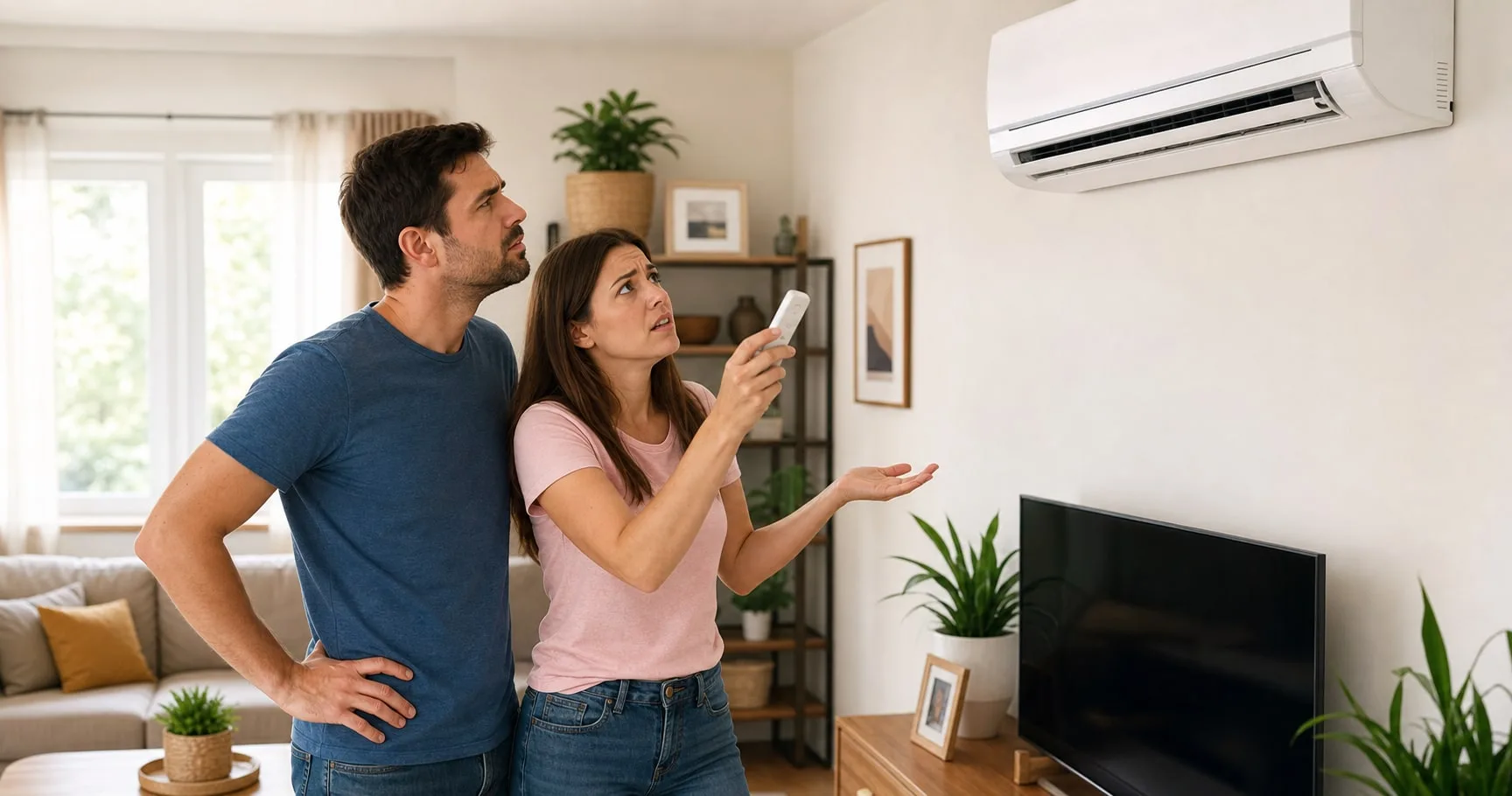
A faint hiss or an occasional click from an indoor air-conditioner unit does not always indicate a serious fault. Plastic can expand with temperature changes, refrigerant can move through the pipes and louvers can make brief operational sounds. If the noise repeats, grows louder and cooling is weak, the fan, icing, drainage and controls need inspection. For a technical inspection, contact our air conditioner technician.
A brief soft hiss when the unit starts or stops may come from refrigerant moving through the system. When it fades within a few minutes and cooling remains normal, it is often part of ordinary operation.
A persistent loud hiss can be associated with airflow restriction, water in the drain path, abnormal pressure or a refrigerant-circuit problem. Weak cooling, ice on the coil or tubing, and water droplets make professional diagnosis more important.
One or two clicks during start-up or shutdown may be the plastic housing reacting to temperature. Clicking that repeats and changes with fan speed can mean the fan blade is touching ice, dirt or a loose component.
If the unit responds to the remote and runs but does not cool the room, the cause may extend beyond the housing. Dirty filters, an iced evaporator, a weak indoor fan, a temperature sensor fault, refrigerant leakage or unstable outdoor-unit operation should be assessed together.
You can explore other repair and maintenance services on the 166 Usta homepage.
A blade touching ice may begin with light clicking and develop into rubbing. Continued operation can damage the wheel and motor. Even if the noise stops after the ice melts, the cause of icing still needs attention.
Switch the unit off for a few minutes, then run it in Cool mode at a suitable temperature and medium fan speed. Confirm that filters are seated, the front panel is closed and the louver moves without sticking. Note whether the sound appears at start-up, when fan speed changes or after shutdown.
Do not put hands or objects inside the unit, turn the fan manually, open the housing or pour hot water on ice. Stop using the system if there is a burning smell, tripped breaker, strong vibration or water leakage.
A technician checks the fan wheel and motor, evaporator, filters, louver mechanism, drain pan, wall mounting and temperature sensor. If cooling is weak, the outdoor unit, temperature difference and system pressure are also tested.
After the source is confirmed, debris is removed, loose parts are secured, the fan or louver is adjusted, or the faulty component is replaced with a compatible part. The goal is to remove the cause, not simply mask the sound.
Inspection is the reliable way to distinguish ordinary operating sounds from icing, fan trouble or a loose mechanical part. If your air conditioner is noisy and no longer cools normally, contact 166 Usta before the fault becomes more serious.
To arrange help from our air conditioner technician, call +994 50 274 92 92 or +994 50 274 92 92, or use our contact page. Describe the problem and provide your address so we can clarify the work and a suitable appointment time.