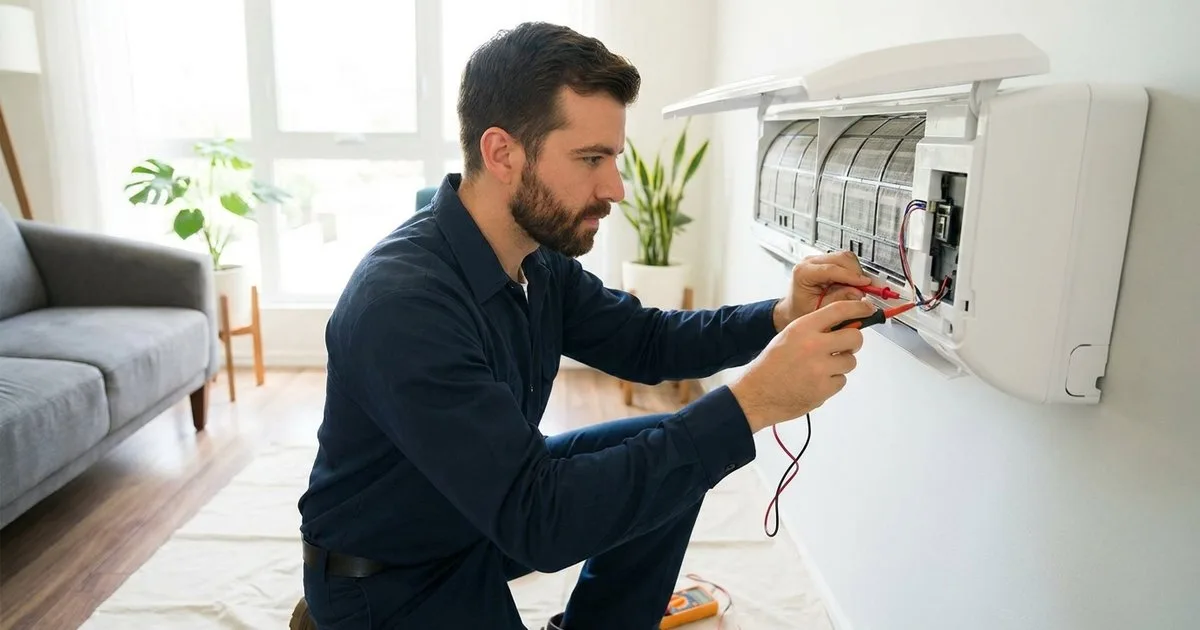
On hot summer days in Baku, an air conditioner suddenly losing its cooling power is one of the most common problems. Often the unit runs, the fan spins and air blows out — yet the room never gets cooler. This not only ruins comfort but, if left unaddressed, can lead to expensive failures such as a burned-out compressor. In this article we explain why an AC stops cooling, what you can safely check yourself at home, what you should avoid doing, and how a professional technician's diagnostic works. For a technical inspection, contact our air conditioner technician.
Cooling problems usually come from a few typical causes. The most common is a shortage of refrigerant (freon) — a leak in the pipework or gradual yearly loss reduces the gas level and the unit loses cooling capacity. The second frequent cause is clogged filters and a dirty outdoor-unit radiator; a layer of dust blocks airflow and heat exchange. In addition, a faulty compressor, a defective control board, a failed fan motor, or a misreading temperature sensor can all stop the cooling.
Before calling a technician you can run a few simple checks. Make sure the remote is set to "Cool" mode (snowflake icon) and the temperature is set to 22–24°C. Open the front cover of the indoor unit and remove the air filters; if they are thick with dust, wash them in lukewarm water, dry them completely and refit them. Check that the outdoor unit is not blocked by objects or leaves and that ventilation is clear. Also check that the circuit breaker (fuse) has not tripped.
You can explore other repair and maintenance services on the 166 Usta homepage.
Do not try to recharge the freon yourself — it requires special equipment and pressure measurement, and incorrect charging can completely destroy the compressor. Do not repeatedly switch the unit on and off when it is not working, as this puts extra strain on the compressor. Do not open the outdoor-unit panels or touch electrical parts with wet hands. If cooling is weak, do not set the temperature far too low (16°C) and run the unit non-stop for many hours — this accelerates freezing and failure.
The professional air conditioner technician service from 166 Usta pinpoints the problem on site. Technicians measure freon pressure with a manometer, find and fix the leak, vacuum the system when needed and recharge the gas to the standard required amount, test the compressor and control board, and professionally clean the indoor and outdoor units. With the support of an electrician, power-supply and breaker issues are resolved too.
During diagnostics the technician clarifies the unit's brand and model, how many years it has been in use, the last service date, whether cooling stopped completely or just weakened, and whether there is unusual noise or ice forming on the outdoor unit. This information helps determine faster whether the issue is related to freon, electronics, or a mechanical part. Home cleaning services are available at 166temizlik.az, and the wider technician network at 166.az.
To arrange help from our air conditioner technician, call +994 50 274 92 92 or +994 50 274 92 92, or use our contact page. Describe the problem and provide your address so we can clarify the work and a suitable appointment time.